
Economies the world over are facing different sets of challenges.

Why try to time the market when time in the market works better? History shows that patient investors who stay the course often walk away with the real rewards, says Ramalingam Kalirajan.
For risk-averse investors, there is a choice of a wide range of debt products. Each of the products has its own utility, depending on your goal and investment horizon.

Russians are not only facing 'fuel and sustainment' problems but are showing signs that they are running out of food, the official claimed, adding that the Ukrainian 'resistance' also could be a possible reason for the stall.

Despite the current bout of volatility, debt-oriented hybrid funds remain well suited for risk-averse investors.

Younger people, who usually have a longer investment horizon which allows them to handle the interim volatility, may go for them.

'Any normalisation exercise will bring its share of volatility.'
Usually, the equity markets carry a bad omen of being a gambler's haven, with high returns equally complementing high risks.
Japanese Yen is experiencing an up trend lately, especially after the Japanese government raised its assessment of Japan's economy for the first time in three years.

Thanks to a booming market, India now has more than 300 family offices, up from 45 in 2018, according to a PwC report. The number is expected to grow rapidly, with promoters establishing more businesses in Tier-II and Tier-III cities. Family businesses play a crucial role in India's booming economy, spanning manufacturing, retail, real estate, healthcare, and finance.
Fixed deposits have conventionally been popular investment avenues among risk-averse investors

The rupee plunged 61 paise to decline below the 83-mark for the first time against the US dollar on Wednesday amid unabated foreign capital outflows and a strong dollar in the overseas markets.

The rupee depreciated 39 paise to an all-time low of 82.69 against the US dollar in early trade on Monday as elevated crude oil prices and risk-averse sentiment among investors weighed on the local unit. Moreover, a negative trend in domestic equities and firm American currency sapped investor appetite, forex traders said. At the interbank foreign exchange, the rupee opened at 82.68 against the greenback, then slipped further to 82.69, registering a fall of 39 paise over its previous close.

The rupee depreciated further by 13 paise to hit a new life-time closing low of 82.30 against the US dollar on Friday as a firm American currency and risk-averse sentiment among investors weighed on the local unit. Moreover, a negative trend in domestic equities and elevated crude oil prices sapped investor appetite, forex traders said. At the interbank foreign exchange market, the local currency opened at 82.19, then fell further to 82.43. It finally settled at an all-time low of 82.30 against the American currency, registering a decline of 13 paise over its previous close.

Fitch Ratings on Monday said it expects a moderately worse sector outlook for Indian banks for the next fiscal beginning April 1 based on muted expectations for new business and revenue generation, and deteriorating asset quality. Fitch believes that the disproportionate shock to India's informal economy and small businesses, coupled with high unemployment and declining private consumption, have yet to fully manifest on bank balance sheets. The rating agency said the impact of the COVID-19 pandemic is likely to pose challenges to Indian banks' improving financial performance once asset-quality risks manifest in the financial year ending March 2022.
In the capital markets, one must see the portfolio as a whole and understand how certain losses are impacting the total portfolio.

The recent run on the US-based Silicon Valley Bank (SVB) and the subsequent seizure of its assets by the regulators may have sparked a global wave of risk aversion, particularly for start-ups. However, the Indian banking sector is unlikely to be a victim of any contagion effects, said analysts. he bank, which played a big role in financing start-ups and technology players, faced stress after incurring huge losses on its holdings of US bonds, following the most-aggressive monetary tightening cycle by the Federal Reserve in around four decades.
The rupee gained 11 paise to 82.68 against the US dollar in early trade on Tuesday as the American currency retreated from its elevated levels. Forex traders said sustained foreign fund outflows weighed on the local unit and restricted the appreciation bias. At the interbank foreign exchange, the domestic unit opened at 82.69 against the dollar and marginally rose to 82.68, registering a rise of 11 paise over its previous close amid a positive trend in domestic equities.

Dealers attributed the fall in rupee to dollar's gains against euro overseas
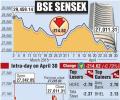
The 30-share Sensex ended down 215 points at 27,011.

'Our advice is to put money into equities now rather than staying away.'

A depreciating rupee, which briefly hit 80 to the dollar on Tuesday, may boost India's exports but price-inelastic imports of crude oil and gold would mean limited relief on the trade deficit, which clocked a record $26.2 billion in June. Due to global risk aversion on the back of geo-political tensions and aggressive policy tightening by the Fed, the dollar has appreciated against most currencies, including the rupee. And, with other currencies depreciating, India's comparative advantage in this respect may be limited.

'I get enormous pleasure from seeing the uplift of an underprivileged or poor person.' 'I feel elated when I walk on the street and see someone who pushes a handcart talking on a cell phone.' A revealing glimpse from Peter Casey's The Story of Tata: 1968 to 2021.

If you are overweight on fixed-income instruments, go for ELSS, and vice versa.

Benchmark indices declined for the third day running on Tuesday, with the Sensex tumbling 567.98 points amid weak global markets and continuous foreign funds outflow. Investors were risk averse ahead of the RBI's policy decision on Wednesday, traders said. The 30-share BSE Sensex tanked 567.98 points or 1.02 per cent to settle at 55,107.34.

Equity benchmark indices fell sharply on Tuesday, with the Sensex tumbling nearly 844 points, in line with weak global market trends and foreign fund outflows. The 30-share BSE benchmark slumped 843.79 points or 1.46 per cent to settle at 57,147.32. During the day, it tanked 940.71 points or 1.62 per cent to 57,050.40.

Investors with high risk appetite must stay invested while risk-averse investors can consider profit booking.

Few finance ministers announce any taxation measure that could upset the stock market. Ms Sitharaman decided to take that risk, observes A K Bhattacharya.

Switching to the UPS could be a game-changer for your retirement planning, especially if you value guaranteed benefits and higher government contributions, observes Ramalingam Kalirajan.

The combined market capitalisation of Adani Group companies fell by Rs 54,876 crore, to Rs 10.92 trillion, as investor sentiment turned bearish on Wednesday. Shares of Adani Transmission fell by 7.7 per cent to close at Rs 886 while those of Adani Power lost 7.1 per cent to end the day at Rs 323. The stock of Adani Enterprises, the flagship company of the group, lost 6.2 per cent to finish at Rs 2,530.

'Investors may have made money in mid and smallcaps due to market momentum, but now they need to focus on fundamentals.'

'Avoid taking excessive credit risk via mutual funds such as high-yield fixed maturity plans and credit opportunity funds.'

Keki Mistry, bottom, left, vice-chairman, Housing Development Finance Corporation (HDFC), tells Joydeep Ghosh that debt fund investors could become risk-averse, leading to problems for other non-banking financial companies.
Global risk aversion and India's widening current account deficit have dragged the rupee close to all-time low.
Want to be an entrepreneur and don't know where and how to start? Here, Prof Dhargalkar head of InnoWE, the Entrepreneurship Cell of Welingkar Institute from Mumbai lists the 10 things an aspiring entrepreneur must do.

Mayank Yadav should be on the plane to Australia if Mohammed Shami is not available for selection, asserted Brett Lee, one of the most destructive fast bowlers of all time, who has high hopes from the Indian pace sensation on the true, bouncy wickets Down Under.

'Calendar year 2023 is going to be big as pessimism takes a back seat.'

Forex dealers said strength of the dollar overseas weighed on the rupee

'Gold could benefit from the resulting risk aversion, as happened last year.'

In May 2014, FIIs were net buyers by Rs 20,225 crore (Rs 202.25 billion).
